

Pig Brig Trap Systems and NWCOA Launch Feral Hog Management Certification Program
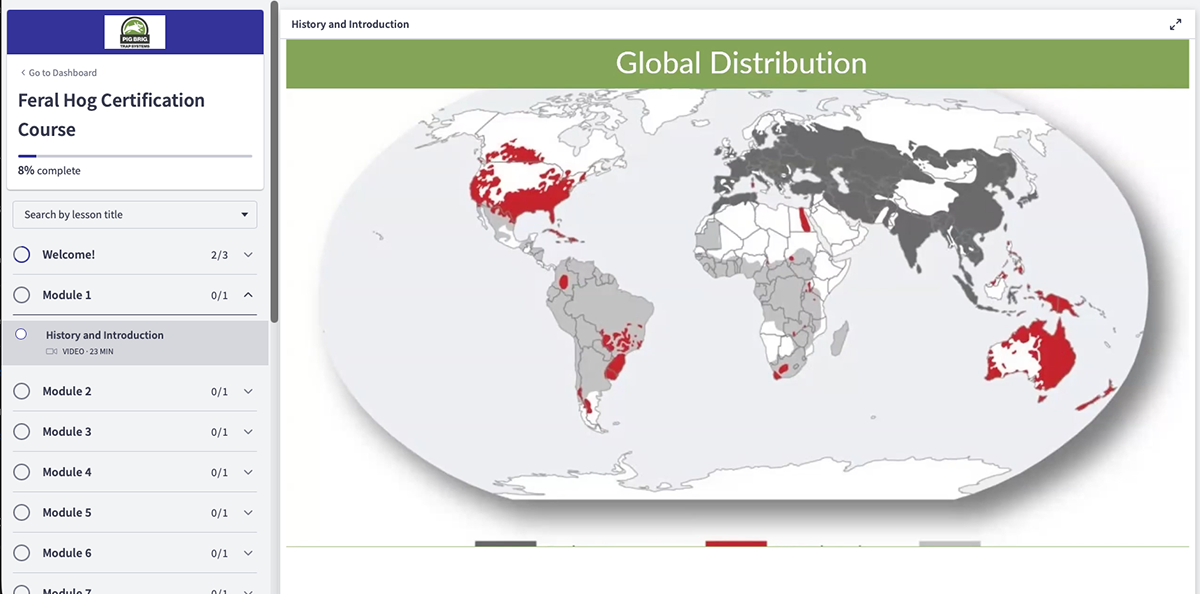
An image from the certification course shows the global extent of the feral hog problem

The course shows where the feral hog problem in the U.S. continues to grow and what can be done to contain it.
New professional certification provides comprehensive training in feral hog biology, management, trapping and field practices
The new certification addresses a challenge that extends well beyond knowing how to trap a hog. Effective feral hog management requires understanding how hogs behave, why populations expand, how they use the landscape and how management decisions can affect results and non-target species. The program brings those elements together in a single course that can serve people approaching the problem from different perspectives.
“Feral hog management is not just about choosing a trap or learning a particular technique,” said Aaron Sumrall Ph.D., Director of Outreach, Education and Research at Pig Brig Trap Systems. “You need to understand the animal, the land and the management options available to you. We built this course to provide that bigger picture. Whether you are trying to protect your own property or building a business helping others manage feral hogs, you should come away with a much stronger understanding of what it takes to address the problem effectively.”
The Level 1 Species-Specific Certification begins with the fundamentals of feral hog biology and behavior, including reproductive capacity, intelligence, movement, seasonal behavior and the environmental factors that contribute to population expansion. It also examines the ecological and economic consequences of feral hog activity, including impacts on native species, livestock and crop production, as well as disease and food-safety concerns.
From there, the course moves into management planning and practical application. Participants learn how to develop site-specific management plans based on their goals, resources and ecological conditions, with additional instruction addressing small-scale and urban environments.
The field-focused portion covers baiting, legal management methods, trap types and operation, behavior-based and advanced trapping strategies, and practical field tactics. The program also addresses what happens after a successful catch, state-level regulatory considerations and best practices for minimizing impacts on non-target species.
That breadth is intended to make the certification useful for people with different objectives. A landowner dealing with damage can develop a better understanding of what an effective management effort requires. A wildlife control professional can build knowledge needed to add or strengthen feral hog management services. Others working in land and wildlife management can gain a more complete understanding of how feral hogs interact with the landscapes they manage.
The certification is available for $245 for NWCOA members and $295 for non-members. For additional information or to enroll in the Feral Hog Species-Specific Certification program, visit: https://nwcoa.thinkific.com/courses/Feral-Hog-Certification-Course
Brooke Lloyd
Pig Brig
+1 740-485-2729
brooke@pigbrig.com
Visit us on social media:
LinkedIn
Instagram
Facebook
YouTube
X
Legal Disclaimer:
EIN Presswire provides this news content "as is" without warranty of any kind. We do not accept any responsibility or liability for the accuracy, content, images, videos, licenses, completeness, legality, or reliability of the information contained in this article. If you have any complaints or copyright issues related to this article, kindly contact the author above.
